Stacy Cacciatore Dissertation Speech July 2, 2021 4,676 words for 30-minute presentation Thank you all for joining my dissertation defense today on Princesses, Divas, and Mother Runners: Gendered Institutional and Vernacular Rhetorics in Running Events. From a logistics standpoint, I want to drop a link to the script in the chat window so you…
Read moreCategory: Ph.D Digital Portfolio
Stacy Cacciatore’s Exam Defense: Speech
<<Slide 1 Opening>> <<Slide 2 Quote>> “No one prepared me for living life as a fat person.” I re-read that statement from Jacqueline Brady several times and reflected on how her mother prepared her for life as a black woman but didn’t warn her of the teasing, taunting, and judgment she would face as a…
Read moreStacy Cacciatore’s Exam Defense: Every ‘body’ can run
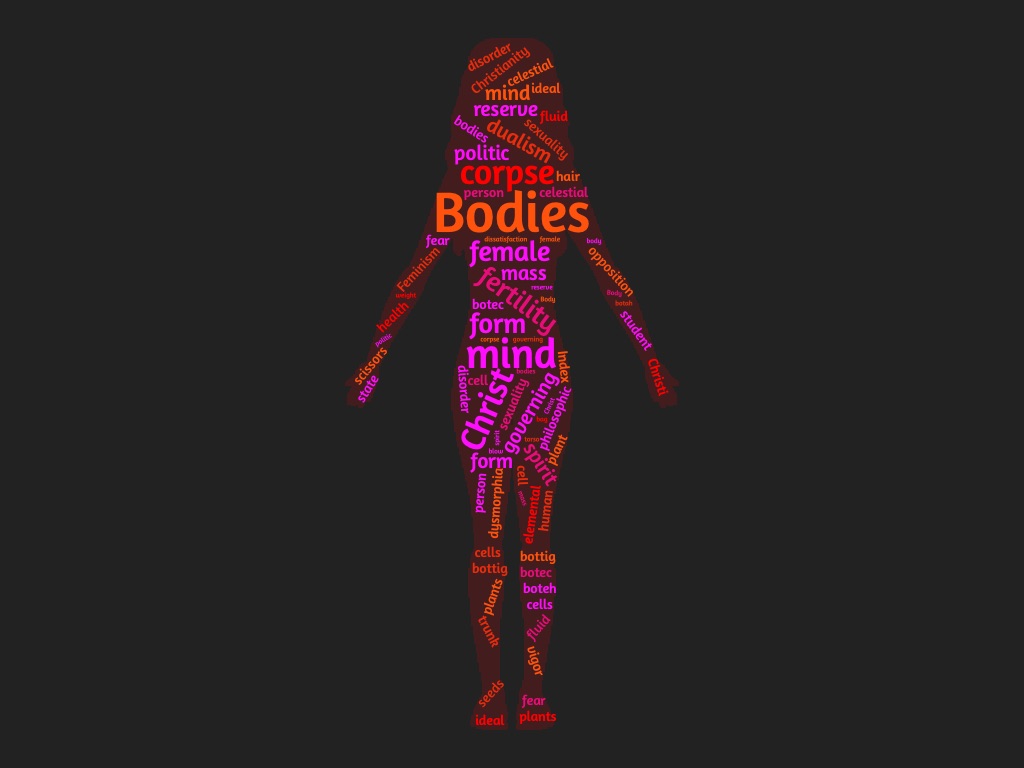
Body WordCloud
Phenomenology
Phenomenology is the study of structures of consciousness as experienced from the first-person point of view. In qualitative phenomenological research, lived experience refers to a representation of the experiences and choices of a given person, and the knowledge that they gain from these experiences and choices. Phenomenology as a methodological framework has evolved into a process that seeks reality in individuals’ narratives of their lived experiences…
Read moreBarr, Liz. “Feminism, Epistemic Authority, and Biomedical Activism
Barr, Liz. “Feminism, Epistemic Authority, and Biomedical Activism.” Feminist Rhetorical Science Studies: Human Bodies, Posthumanist Worlds, Southern Illinois University Press, 2018, pp. 205–226. Barr coins the term “embodied vernacularity” which “accounts for the speaking body in addition to the spoken word” (206). The scholarly conversation in which Barr is contributing is a body of research on…
Read moreJack, Jordynn. “How Good Brain Science Gets That Way: Reclaiming the Scientific Study of Sexed and Gendered Brains
Jack, Jordynn. “How Good Brain Science Gets That Way: Reclaiming the Scientific Study of Sexed and Gendered Brains.” Feminist Rhetorical Science Studies: Human Bodies, Posthumanist Worlds, Southern Illinois University Press, 2018, pp. 164–182. Jordynn Jack calls for feminist rhetoricians to look beyond the results of scientific research to better understand how the conclusions were reached. She…
Read moreSonia, Kruks. “Simone De Beauvoir: Engaging Discrepant Materialisms.” New Materialisms : Ontology, Agency, and Politics
Sonia, Kruks. “Simone De Beauvoir: Engaging Discrepant Materialisms.” New Materialisms : Ontology, Agency, and Politics, Duke University Press, 2010, pp. 258–280. The larger theoretical trend that Kruks draws our attention to is Simone de Beauvoir working in and across both phenomenology and a Marxist-inflected culturally oriented structuralist materialism. While Beauvoir is often read as phenomenology, she…
Read moreDISABILITY EXPERIENCE ON TRIAL
Stacy Alaimo & Susan Hekman. Material Feminisms . Indiana University Press. Kindle Edition. Siebers (2008) discusses disability discrimination and the difficulty in overcoming these prejudices because our society is “discrimination by design”. Siebers quotes Jean-François Lyotard’s (1988) definition of différend “as a situation in which victims are denied the means to demonstrate that they have…
Read moreThe Five Canons of Rhetoric
The Five Canons of Rhetoric In De Inventione, the Roman philosopher Cicero explains that there are five canons, or tenets, of rhetoric: invention, arrangement, style, memory, and delivery. Although these canons were originally created with a focus on oratory, or public speaking, most are also applicable to the writing process stages of prewriting, drafting, and…
Read more