stacy
stacy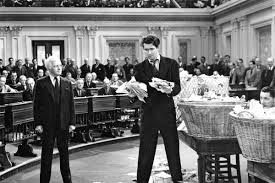 In Mr. Smith Goes to Washington, we meet Jefferson Smith a naïve scout leader who is brought into a position of Senator because it is believed he will follow orders. Throughout this movie, I noticed was that Smith seemed to act more like a boy than a man. One component that wasn’t clear to me was Smith’s motivation for so strongly advocating for the Boy Rangers. We see on the Senate floor the boys of the Boy Rangers going wild in the audience when Smith speaks about the proposed campsite. I believe that the director is attempting to portray that Smith is a boy himself. We see Smith fidgeting with his hat when speaking with Susan, trembling at the podium when giving a speech and naively trying to pass a bill without any understanding of how the process works. He is a child thrust into an adult world. In this sense, the movie reminds me of Big, with Tom Hanks. In Big, Tom Hanks’ character is a boy in a man’s body and is thrust into the world of adulthood, complete with working at a large corporation and dating a beautiful woman, neither of which he knows how to handle. When Josh Baskins’ (played by Tom Hanks) invites Susan Lawrence (played by Elizabeth Perkins) over to his house for a sleepover, he asks her if he can be on top, hilariously referring to the top of the bunk bed, not exactly what she had pictured. This childhood innocence in an adult relationship providing comedic relief. Interestingly, we see a similar theme with Jefferson Smith (played by Jimmy Stewart) and Susan Paine (played by Astrid Allwyn) (and notice both of their names are Susan). Did you notice this theme of boyhood in Mr. Smith Goes to Washington? Did you notice similar parallels with this movie and Big?
Capra, Frank, director. Mr. Smith Goes to Washington. Columbia Pictures, 1939.
Marshall, Penny, director. Big. Twentieth Century Fox Film Corporation, 1988.