stacy
stacyI had never seen a Hitchcock film before, so watching Vertigo (1958) and reading Blakesley’s Defining Film Rhetoric: The Case of Hitchcock’s Vertigo in Defining Visual Rhetorics (2004), was quite eye-opening for me. Blakesley (2003) defines four approaches to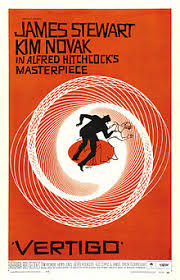 film rhetoric (film as language, film as ideology, film interpretation and film identification) and he explains how each approach contributes to our broader understanding of visual rhetoric. Blakesley (2003) states that film identification “considers film rhetoric as involving identification and division. Film style directs the attention—or not—for ideological, psychological, or social purposes” (7). He uses this approach to analyze Vertigo (1958), which makes sense considering identification is the central theme in the film. I noticed this theme of identification in the scene with the close up of Madeline’s (in real life) and Carlotta’s (in the painting) hair buns. The viewer immediately is able to make the connection between the correlation and identification of Madeline and Carlotta. The twirl in the bun also signifies swirling Scottie feels when vertigo overcomes him.
In that same camera shot, Hitchcock draws us in with a closeup of the necklace, foreshadowing its’ significance later in the film, as the necklace is what helps Scottie connect the pieces together that Judy was Madeline. The bun and the necklace both signify the identification theme in the movie, with Madeline identifying with Carlotta and Judy identifying with Madeline. The painting plays yet another role in identification when Midge paints her own self-portrait in place of Carlotta’s face. She is attempting to identify with Madeline to capture the attention and love of Scottie, but Scottie is too enamored with Madeline to notice or care. The circle of identification and desire for what one can’t have is a theme throughout the movie. Blakesley (2004) states, “The aim of rhetoric, according to Burke, is identification. From the perspective of the audience, or the spectator, identification functions as desire, as an assertion of identities, such that while there may be division or differences among people or characters, we pursue that identification as one way of expressing (or asserting) our consubstantiality” (117). We see this consubstantiality through Scott’s infatuation with Madeline. This point is reinforced at the scene in which Madeline falls to her death, as Hitchcock ensures we see Madeline’s body after she fell, but the last thing we see before Judy jumps to her death is the nun. This is because the identification with Judy ends with her death. Blakesley points out, what is communicated is through what is notseen vs. what is, as Burke would describe as a “a way of seeing is also a way of not seeing” (112). After reading Blakeley’s analysis of Vertigo and application of film identification, I was able to have a deeper understanding of the rhetorical significance of the film.
Blakesley, David. “Defining Film Rhetoric: The Case of Hitchcock’s Vertigo.” Defining Visual Rhetorics, Taylor and Francis, 2004, pp. 111–132.
Blakesley, David. The Terministic Screen: Rhetorical Perspectives on Film. Southern Illinois University Press, 2003.
Hitchcock, Alfred, et al. Vertigo.